Pages

Showing posts with label georgian. Show all posts

Friday, August 31, 2012

And now for something a little crazy...

In addition to my love for historical clothing (and lots of other things, but that's for another blog post), I also enjoy learning about the various royal families of Europe. Blame it on the royal wedding last year, my anglophelia, Princess Kate, or whatever you like. The long and short of it is, when I saw this photo of Crown Princess Victoria of Sweden and her husband Daniel, I couldn't believe my eyes.

Source
Yes, they are wearing 1770's-80's clothing. No, it's not photoshopped. Don't get me wrong, it's adorable (Victoria and Daniel are always adorable), but I'm still trying to wrap my brain around it. Make of it what you will.

Wednesday, June 6, 2012

The Regency Ladies did Vintage, Too- the 1800's

The year 1800 saw the turn of a new century, along with the aftermath of the radical changes that took place during the 1790's. In 1799, Napoleon Bonaparte staged a coup d'etat and established himself as the head of government in war-torn France. Pope Pius VI died as a near-hostage to the French, leaving the papal tiara in their possession. Because of this, Pope Pius VII was crowned in Venice in 1800 with a papier-mache model of the original tiara in a crowning moment of sartorial grandeur. In Britain, Prime Minister William Pitt the Younger and Parliament passed the Union With Ireland Act of 1800, uniting Great Britain with Ireland. In the United States, Thomas Jefferson and John Adams ran in a bitter, heated campaign filled with slander and ad hominem attacks on both sides.

In the 1800's, the changes that took place in the 1790's began to slowly evolve into something new, something subtly different. The fashion of the era reflects this.

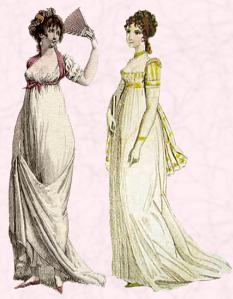
Evening fashions as they stood at the beginning of the decade.

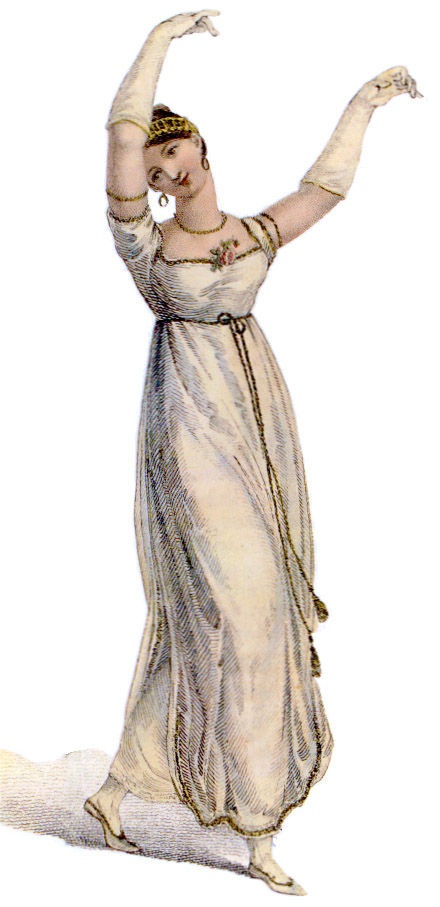
Though the empire waistlines remained popular, a few things subtly changed over the course of the 1800's. As the decade wore on, brighter, bolder colors came more into fashion, as well as jewelry and other ornamentation.
Source
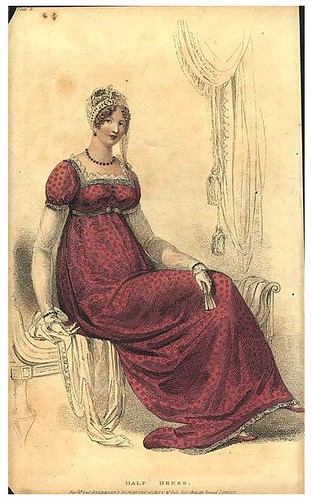
Longer sleeves came into fashion, which for evening wear meant sheer, white sleeves attached to the more colorful, short-sleeved gowns. And yes, fellow 1995 Pride and Prejudice fans who can quote the Mrs. Bennet line about Aunt Gardiner bringing the fashion of long sleeves to Hertfordshire, I'm talking to you.

This picture isn't even from that scene, I just find it hilarious.

A trend that started in the 1790's and continued into the early part of the 1800's was modeling one's hair and wardrobe after ancient Greek and Roman statues (Here's a great article about neoclassic hairstyles and accessories).

A sculpture from about 300 BC sporting an empire waistline characteristic of the late 18th and early 19th centuries.
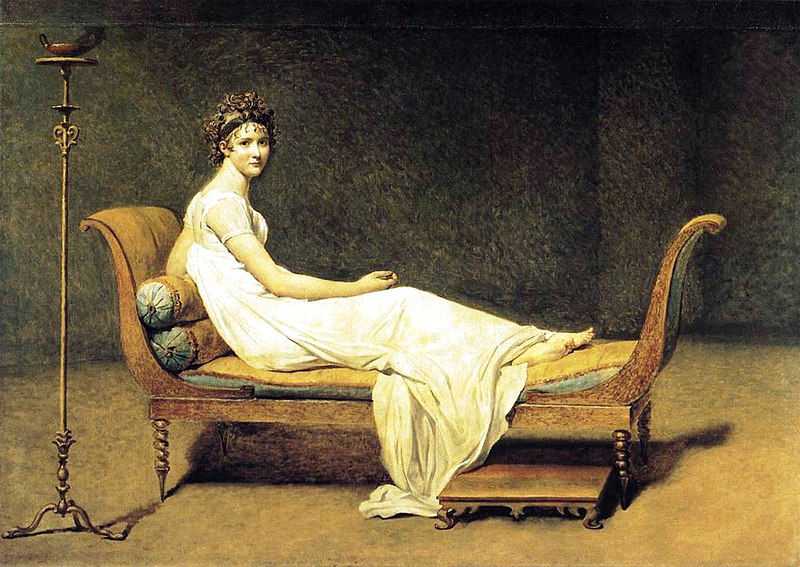
 A portrait from 1800.
The Gothic romance and neoclassicism of the 1790's faded as the 1800's went on. Brighter colors, silks, and jewelry came back into fashion. Earrings seemed to resurface near the middle of the decade. Coral necklaces were a popular accessory of the time (another great JaneAustensWorld article on those here) and stayed in fashion for several years.

A portrait of a woman wearing what looks like a late-decade morning dress. Featuring a coral necklace, earrings, and a gold headband of some sort, as well as some colorful shawls and long sleeves. She looks like she's holding colored gloves. Source.

One last scrap of neoclassic style was found in the tightly coiled coiffures of ladies of the highest fashion- but this time it was more Roman-inspired, with tight, controlled curls rather than the loose, romantic styles of the Greeks.

Louisa Hurst giving an example of a Roman-inspired hairstyle, with bright colors, jewels, and feathers to boot.
As the Regency Era continues (or rather, officially starts in 1811), we'll begin to see what I'd call (from my rather surface-y research into next week) "The Age of the Accessory." After 1810, jewelry and hair accessories continue to rise in popularity and trims become more elaborate as we venture into the 19th century and leave every memory of the 1700s well and truly behind. At least where fashion is concerned.

I couldn't really fit this into the post anywhere, but it was too great not to include. Happy Wednesday, kids.


Wednesday, May 30, 2012

Radical Change- the 1790's


The year is 1790. Two years ago, King George III of England suffered another episode of madness. Last year, the House of Commons passed a bill allowing the Prince of Wales to rule England as his father's regent, but before the regency could take place, the king recovered. General George Washington was elected President of the United States in 1789, and this year passed the Residence Act of 1790, commissioning the construction of a city that would be the headquarters for all American government. England is at war with France, and France is at war with itself.

The 1790's were characterized by many radical changes, and fashion was no exception. In fact, it's difficult to talk about the decade as a whole because clothing from the beginning of the decade differs so greatly from clothing around the turn of the century.

Aah, pretty. Source
Also pretty. Source

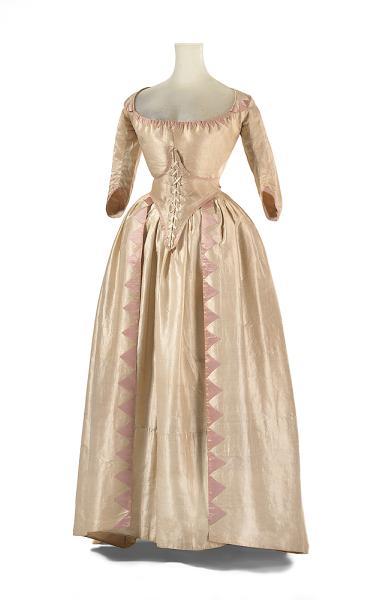
So how did we get from natural waists, tight corsets, and colored silks to pastels, muslins, and loose-fitting empire waist gowns? Zipzipinkspot.blogspot.com has an AMAZING two part blog post on the transition from 1780's fashion to the early Regency. It turns me into a green-eyed monster of jealousy. In a happy way. It's swell.

One thing I found in my 1790's research this week was the fichu (rhymes with 'tissue'), a triangular piece of gauze, netting, or lace pinned onto or tucked into a bodice for modesty during the day. I've seen them around in different Jane Austen adaptations educational films on the period, but I never knew what it was called. 


This and the lighter muslins and linens (in comparison to the heavier, brightly colored silks of the 1770's and 80's) appear to be some of the only things that stay the same from the beginning of the 1790's to the end.
An early decade example of a fichu. Source.

Source

One thing that particularly interested me while researching this period was watching the waistline slowly creep up and bodices loosen as the decade went on. Two good examples of this are in the adaptations of Sense and Sensibility and Mansfield Park. Admittedly, the 2007 Mansfield Park is a little all over the place in terms of costumes (Fanny wears some mid and early decade waistlines, Mary Crawford's getups look like they're from the late Regency, the clothes worn by the Mrs. Norris and Lady Bertram look like they're from the 1780's, and the costumes for the play look like they're from the 1770's, leaving me with the question, "What is this madness?"), but Fanny is a good example of waistlines that are much lower than what we'll see later on in the Regency.

She looks a little squinty here. Source
In Sense and Sensibility, the waistlines are closer to truly empire, but more structured and tailored than we'll see later.

Elinor and Mama Dashwood are both good examples in this image. Source.
Marianne, with a gathered neckline that Zipzip explains in detail. Source.
Skirts also changed, becoming more narrow as the decade wore on, and the train was becoming more and more common. 

Beautiful train. Source.


By the end of the decade, waistlines were high, sleeves were short, and hair was worn looser and curly. The hair powder that was so popular in court fashion in the 1770's and 80's was now completely out of style, and a new era of natural hair and loose clothing was ushered in. After the turn of the century, the skirt would narrow still more, and hairstyles would become more polished and tight, conforming to the inspiration of Greek statues. That's what we'll be looking at next week, when I study the years 1800-1810. And I'll probably use more Jane Austen images. Don't say I didn't warn you.