Pages

Showing posts with label contemporary. Show all posts

Wednesday, October 17, 2012

Fashion in Film: Roman Holiday

This week, I've chosen to take a look at the three costumes worn by Princess Ann in Roman Holiday. This is by far my favorite Audrey Hepburn film, with princesses, adventure, and humor, all set against the beautiful backdrop of Rome. Not to mention fabulous 1950's fashion. Let's take a look.

Source
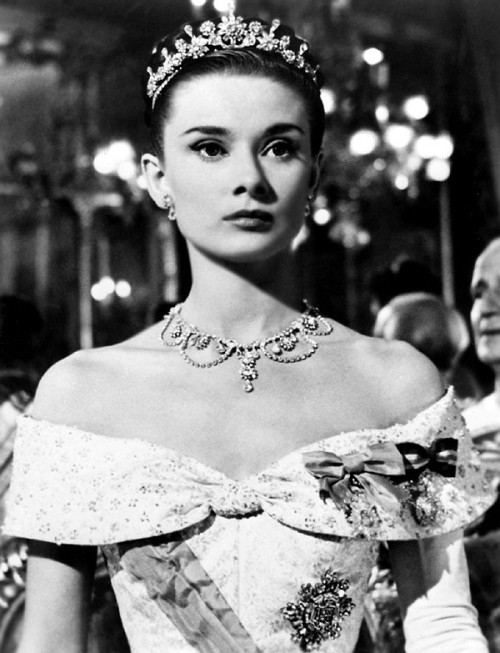
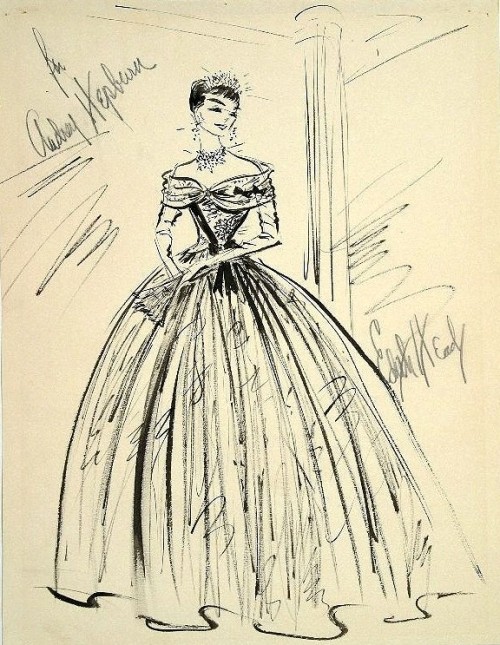
The costumes in the film were designed by the legendary Edith Head, and the first costume she designed for princess Ann is a white gown with a full skirt and an off the shoulder neckline. Several royal orders are pinned to the bodice, and a sash is tied from her right shoulder to a bow at the hip.

Source
Check out the detail on the bodice of the dress. The tiara and necklace are stunning, as well.
Source
This gown is a perfect example of the "New Look" that surfaced at the end of the 1940's, with a full skirt and a tight bodice. One thing that sticks out to me about this gown is that it is white. Of course, the connotations between a luxurious white gown and brides were as firmly fixed in the minds of the 20th century audience as they are today. I can't help but wonder if this is some subtle reference to the state we find Ann in as the film opens: duty-bound (or "married," as it were) to her country and her work. I think the various royal orders she wears corroborate this as well.

The second costume we see is very basic compared to the opulent gown of the opening scene, but it also shows Ann's character change in a definite way. When Ann runs away from the palace, she dons a white button-down blouse, white gloves, and a belted skirt.

Source
Source
Without changing her clothes, Ann manages to completely transform her look. Her blouse sleeves are rolled up, the collar is buttoned down and her white necktie is changed out for a colorful kerchief, and she picks up a pair of very Roman sandals from a street vendor. And of course, an iconic hair cut finishes the look.

Source
You can see the sandals better here.
This incredible transformation shows Ann's mounting independence, and her fancy-free sense of adventure as the film progresses.

The film has a bittersweet ending; Ann ultimately decides to leave the life and the man she loves and return to her royal duties. The last scene of the film takes place at a press conference in which Princess Ann wears a full-skirted lace dress with a v-collar and voluminous elbow length sleeves.

Source
Once again we see that her dress is white. In comparison with the darkly-clad ladies flanking her, Ann looks very feminine and youthful, even overdressed. Perhaps this shows how she's returned to her station as figurehead, being the face of her country.

Other interesting elements of her outfit are her hat and pearl choker.

Source
The hat and necklace are both very high-fashion pieces of the era, in contrast with her second outfit, which has a thrown-together feel to it. I think this shows how she's put her carefree holiday in Rome behind her and has willingly returned to the controlled environment of royal duties.

That wraps up week two of the Fashion in Film series! I'm really enjoying it thus far, especially the opportunity to delve into the costumes of my favorite Audrey Hepburn film. See you next week!

Source
Bonus Round: Check out another great costume analysis of Roman Holiday here.

Wednesday, September 26, 2012

Steady Progress- the 1950's

The year is 1950. Five years ago, World War Two ended, and the USA got a new president, Harry Truman, after the death of Franklin D. Roosevelt. In two years, England will have a new monarch, Queen Elizabeth II. As the Cold War begins, the world is slowly starting to recover from World War Two, and fashion is no exception. Haute couture has made a comeback, and progress is back in motion.

Source
The women of the early 1950's were still enamored with the "New Look" of the late 1940's. Day dresses and evening dresses alike had structured bodices with tiny waists and full skirts.

Source
Source
This silhouette remained popular for the entire 1950's. Slimmer, suit-like dresses also became popular for day wear in the early-mid decade.

Source
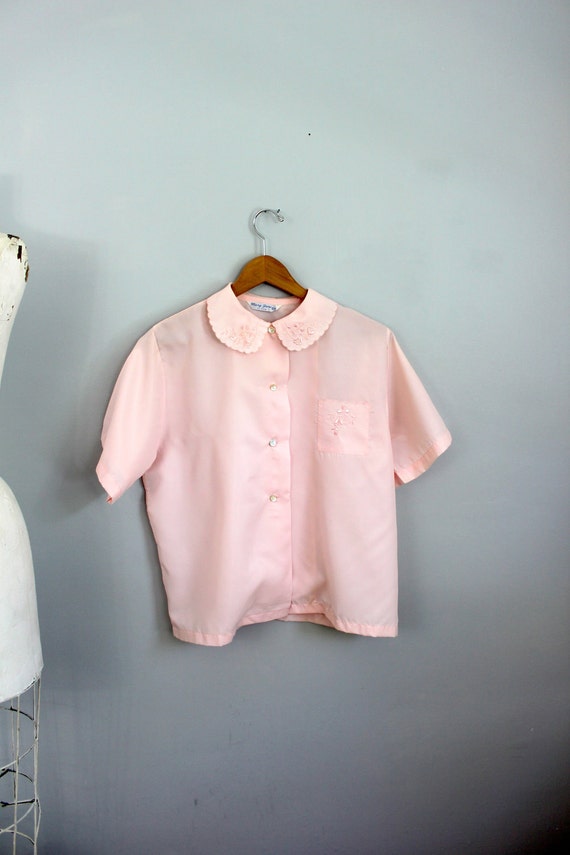
Collars became a focal point for day wear (and on some evening gowns), with the Peter Pan collar becoming very popular.

A 1950's blouse with a Peter Pan collar.
An evening gown that plays with the concept of the accentuated collar.
A popular trait of evening gowns was the ballerina-length skirt, a skirt with a hem right above the ankle.

Source
Chiffon and silk were both popular textiles of the time, and decoration, details, and experimentation was back in full force. After the sleek silhouettes of the 1920's and 30's and the austerity of the 1940's, fashion was celebrating unabashed girliness again.

Source
Source
Source
By the end of the decade, silhouettes slimmed a little, and the boat neckline became popular.

Source
Source
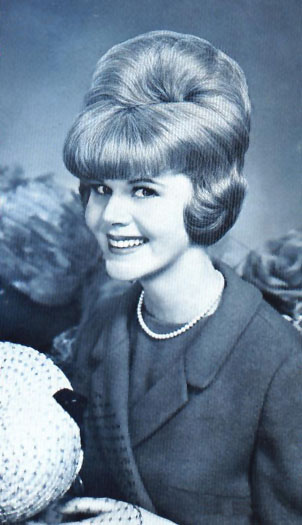
Hair in the early and mid 1950's was usually worn short and curly. As the end of the decade approached and the mod fashion became popular, the iconic beehives and bouffants came into style.

Source
Source

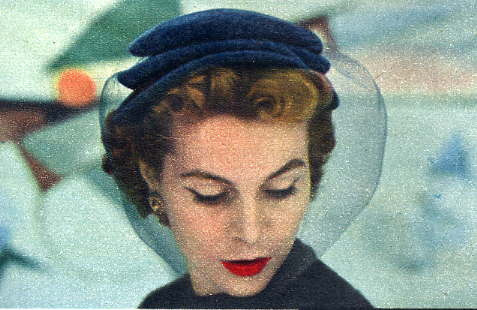
Hats were worn less and less frequently by both men and women. The hats that were worn were small and perched on top of the curled coiffures. Often hats came with birdcage veils.

Source
The 1950's were an exciting time, filled with progress in technology, film (the Golden Age of Hollywood), music, and yes, fashion. It really brings home to me just how much things have changed not only in the 160 years from 1790 to 1950, but in the past 16 weeks in which I've been blogging about these amazing years (not counting that one week where I didn't do a post, we don't talk about that week). To find out more about my passion for historical clothing has been incredible. I've also learned more about the history of the world than I ever though possible, just through researching what went into the clothes people wore. It's truly a blessing to have been through this leg of the Decade Wednesday journey.

Though my 1790-1950 goal has been met, the weekly post element of Sprigged Muslin is far from over. I'm so excited to continue to blog as I learn, and share this amazing world of historical fripperies with you. Stay tuned, lovely things are coming this way.

Wednesday, September 19, 2012

Keep Calm and Carry On- The 1940's

In 1939, the world was once again thrown into war when Britain and France (along with smaller countries of the British Commonwealth) declared war on Nazi Germany after Germany invaded Poland. The war lasted for six years, finally ending on September 2nd, 1945, just a day after its six-year anniversary. Once again, women were called to the workforce in the absence of men, perhaps even more so than during World War I. In several allied countries (and in Axis countries as well), it was one's patriotic duty to do something, anything for the war effort. Women's clothing of the decade reflects this with simple, sturdy cuts and textiles made for years of work and wear.

Now, I'm like the majority of people in that when I think of the 1940's, I think of World War Two. It's unavoidable that the war was a defining event of the decade. But now that it's time to look at the 1940's as a whole, I can't help but wonder, how did fashion change in the five years after the war? Let's find out.


Let's start with the World War Two years and work our way to the end of the decade. By 1940, Europe was already a year into the war, and in the early years of the decade, most of the Western World rationed fabric, as well as completely requisitioning all silk and nylon for military purposes. Women entered the workforce in the place of their absent husbands, brothers, fathers, and sons, and those in more hands-on jobs began to wear trousers out of necessity.

Source
Those who didn't don a welder's helmet or a mechanic's coverall sported simple silhouettes with squared off shoulders, skirts just below the knee, and modest, unobtrusive colors.

Source
Source. This collar was very popular during wartime.
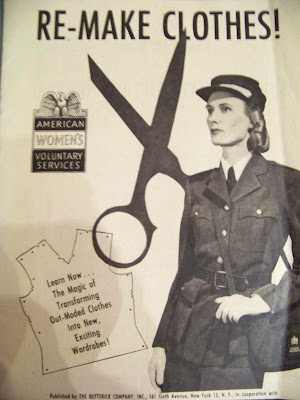
According to Wikipedia, several fashion magazines gave instructions on how to remake men's suits into women's outfits. After all, they were just hanging in the closet, and it was free fabric. The government encouraged reusing clothing with slogans such as "Use it up, wear it out, make it do!" and "Make do and mend."

Source
In addition to dresses and suits, trousers were carrying over into the fashion world (but they wouldn't be widely received until the 1950's). Vests, skirts, and blouses were also popular.

Source
 The war finally ended in 1945, and the wheels of fashionable progress were turning once again. In 1947, Christian Dior released a style of dress that was dubbed "The New Look." These dresses foreshadowed the 1950's, with longer, fuller skirts, accentuated tiny waists, and full busts. To top it all off, Dior used an exorbitant amount of fabric to create these new dresses, which was a far cry from the strictly rationed fabric of the first half of the decade. Luxury fabrics like silk and colors also came back in full force, almost like a celebration of victory and the joy of being on the other side of the worst war the world had ever seen.

Source
Source. Very I Love Lucy.
Source
Evening wear was also revolutionized in 1947 , when strapless dresses with long, full skirts and plenty of decoration and details first hit the runways.

Source
Hair was commonly worn in shoulder-length curls, with popular "victory rolls" on the top of the head, or waved bangs framing the face, or low buns at the nape of the neck with pin curls. Women experimented with intricate hairstyles that all had one thing in common: lots and lots of curl.

Source
Source
Source
Source
Hats were much like those of the 30's, medium-sized, with creative decorations and worn at a jaunty angle. While everything else during World War Two remained simple due to rationing, the materials used in hats were not rationed, so milliners continued to make them fancy and fun. Here's a WONDERFUL article on hats during World War Two.

Source
Next week, we'll take a look at the 1950's, the Golden Age of Hollywood and (for those of you keeping score at home) the last installment of this leg of the Decade Wednesday journey. Tune in next week for the dramatic conclusion! Until then, flip through a LIFE magazine from 1942, and experience World War Two in real time. See you next week!