Pages

Wednesday, July 25, 2012

"This war talk's spoiling all the fun"- The 1860's

Some heartbreaking events in history took place during the 1860's. In Britain, Queen Victoria suffered the death of both her mother and her husband, Prince Albert. Her public life was effectively over; she withdrew from the political spotlight (although she carried on her duties in private), and wore black for the rest of her life.


Meanwhile, in America, a presidential election was underway. Abraham Lincoln ran against John C. Beckinridge and won by a solid majority. A short time afterwards, the American Civil War began, turning the North and South against one another. The war finally ended in 1865, only a few weeks after President Lincoln was shot and killed by John Wilkes Booth.

After the frolicking fun of the previous decade, the 1860's were a sobering dose of reality. This is reflected in the slightly plainer clothes of the era. It seems like whenever there's a major war, the economy and other factors of wartime life influence the clothing to be plainer and more built for work. We'll see this again during the end of the Edwardian Era with World War I, and again in the 40's during World War II.

Source
At the beginning of the 1860's, sleeves were wide near the bottom as they were in the previous decade. As the decade progressed, narrow sleeves also became popular, and both kinds of sleeves were seen commonly for day wear. Short, fitted sleeves remained par for the course in the evening.

Source
One thing I'm noticing about the bodices is that we've lost the v-shaped panels of fabric iconic of the 1850's. Instead, bodices are square and structured, with buttons down the front. Several gowns for both day and evening were two-piece. According to Wikipedia,

"A skirt might be made with two bodices, one long-sleeved and high neck for afternoon wear and one short-sleeved and low-necked for evening."

It appears as though bodices and skirts were sometimes mixed and matched.

Source
Skirts changed slightly in the early-mid decade. Instead of having volume everywhere like in the previous decade, the bulk drifted to the back of the skirt, and slight trains came into fashion.

Source
The fullness in the back of the skirt paired with the straight, natural a-line of the front to me looks like a forerunner for the early bustles that we'll see in the 1870's. Some skirts in this decade even look like they're supported by bustle pillows.

Source
Trims, although not as large or as fancy as in the 1850's, were still pretty popular for both day and evening.

Source. Looking at this dress and others that were made in the USA makes me think that silk, although still very popular, wasn't as overwhelmingly used in America as it was in Europe.

Lace seems like it's declining in popularity (perhaps by necessity). Though it's still seen on some evening dresses, it's in much smaller quantities than in the 1850's.

A gorgeous peach ballgown with a little bit of lace accent on the neckline. Also check out the trim and the buttons on the bodice.
Now, this is the fun part. Guess what I'm watching right now? Gone With the Wind. Otherwise known as the perfect movie to watch while writing this post. It's my first time watching the film, and there are two things I really love about it: 1. The way Mammy tells it like it is, and 2. Scarlett's dresses. And no post about the 1860's would be complete without a (very) mini Gone With the Wind costume analysis. Of course, I could be persuaded to do a proper one later. You never know. Here's a quick look at Scarlett's first two costumes in the film.

Source
Scarlett's first costume is stuck in my mind. It's very late 1850's, with tiers and ruffles and a massive hoop skirt. The bodice also foreshadows the mid 1860's with its buttons in the front. For some reason, though, the bodice does feel a little 1930's-40's to me. Maybe it's the red belt. Or the hair. Either way, I still love this puffy cloud of a dress.

Source
The green and white gown that Scarlett wears to the picnic at Twelve Oaks is my family's pick for favorite costume in the film thus far (we're halfway through the epic 4-hour film). The ruffles-and-bows neckline is very accurate, as is the print. The pointed end to the bodice is another hallmark of the late 50's-early 60's, although I'm not 100% sure about the silk sash. The gauzy material isn't exactly period, but it is really pretty, and it moves beautifully.

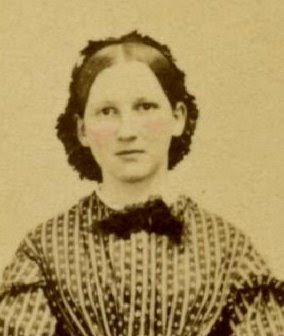
Hair was worn parted down the middle, in low buns often involving braids and ringlets. In the evening, they were decorated with ribbons, flowers, and other fun doodads.
Source
During the day, hair was often gathered into hairnets. Said hairnets were sometimes decorated with ribbons or small pearls.

Source
When most people think "Victorian fashion," they think of bustles, tiny fascinators, button-up boots, and a plethora of things iconic of the last three decades of the 19th century. Next week, we'll see the beginning of that era. For now, because I can't bear to have a post without a painting by Franz Xaver Winterhalter, I'll leave you with one of his most famous works, a portrait of Empress Elisabeth of Austria painted during the 1860's.

Source

Monday, July 23, 2012

Historical Dress Up Games

Source
I have a confession to make. I love playing dress up games online. It's a way to let my childish side run rampant and to relax for a while. It ranks right up there with fan fiction for the top spot on my list of internet guilty pleasures. So, without further adieu, here are a few historically accurate games that I keep coming back to over and over again.

The Tudors Scene Maker has a huge amount of items hailing from the late 16th and early 17th centuries for both male and female characters, who can be customized and arranged in scenes. The combinations and possibilities are endless.

Savivi on DeviantArt.com created four great games: Regency Hero, Regency Heroine, 18th Century, and Soulless Victorian. All of them have great art quality, great clothes, and are greatly enjoyable.

Last but not least, we have my favorite game on the list, Erte Elegance, which allows you to build your own 1920s evening gown. It's deliciously glamorous, and you can tell that the creator of the game really did their research. 


Bonus Round: It won't be out for another month or so (unless you happen to have a subscription to Dolldivine.com, in which case you can play the beta testing version), but the Dandy Maker looks like it will be a doozy. According to the preview image, there's a whole section of the game devoted to cravats. Sign me up.

Friday, July 20, 2012

Book Review: Fashion Sourcebook 1920's

Source
A couple months ago, I found myself working on a costume project that required a pretty extensive knowledge of the 1920's. Being the relative costume novice that I was (and still am, to some extent), I really only had a smattering of expertise about the Regency and Victorian eras, and next to no knowledge about the 20th century. So I decided (mostly out of necessity) to become an expert on the era overnight. After exhausting every resource on the internet, I turned to books, and this gem came into my life.

Fashion Sourcebook 1920's by Charlotte Fiell and Emmanuelle Dirix is an enormous brick of gold for fashion history enthusiasts, with pages upon pages of design sketches and photographs from the era, separated into categories of Daywear, Eveningwear, Outerwear, Accessories, and much more. It gives a clear look of both high fashion and everyday clothing in the Roaring 20's that's both educational and fun. There's also an informative forward with a comprehensive look at the elements of early 20th century life that shaped the world of fashion.

Another great feature of the book that I loved was the designer's index in the back, with a short biography of each designer, and a list of where their designs appear throughout the 576 page book. My favorite designer in the book is Atelier Bachroitz, whose feminine, whimsical, but still totally modern designs stood out among the sleek, straight lines of his contemporaries.
Source
Fashion Sourcebook 1920's is a helpful and truly enjoyable resource. It was a lifesaver for my work, and an incredible addition to my ever-growing fashion history library. Find out more about the book at its website, and click here to purchase.

Wednesday, July 18, 2012

Belles and Bells- The 1850's

Gorgeous painting by Franz Xaver Winterhalter.

After the slight dip that was seen in the 1840's, the 1850's brought accessorizing and decorating back with a vengeance.


The pointed waist that we saw in the 1840's remained popular in the 1850's, monopolizing evening wear and remaining very, very popular until the end of the decade and the early 1860's, when it disappeared without a trace.
Absolutely breathtaking. It looks like lace was a popular accent in the late 1840's and 1850's.
The off-the-shoulder neckline, seen in both of the above images, carried over from the 1840's and remained very popular in evening wear for the entire decade. While digging around various places on the internet, I've also seen one or two instances of off-the-shoulder sleeves in day wear.
Source
By about 1854-55, another development came in the bodice for day wear. Panels of fabric that started at the shoulders and crossed over in a v-shape to the waistline became iconic of the 1850's and 60's.  As well as fabric that matched the rest of the dress, lace shawls provided the same shape.

Source
Source
Also by about the middle of the decade, the sleeves on day dresses changed. In the 1840's, sleeves were narrow and natural the whole way down, but by 1854-55, they widened significantly at the bottom, and sometimes had a puffy sleeve underneath that gathered at the wrist.


Source
In the latter half of the decade, bold prints and patterns were popular for both day and night.


Source


Source
So, you may have noticed that I'm saving the best part of the garment for last here. It's (almost) literally the elephant in the room. Since the late 1820's, the skirts have been rapidly growing, from narrow to conical to bell shaped to what we now have; nearly spherical skirts supported by hoops, crinolines, flounces, anything that will support their staggering girth. They're like the Stay Puft Marshmallow Man of historical fashion, deliciously enormous and totally out of control. And strangely enough, I sort of like it. The skirts were heavily decorated with flounces, trims, lace, bows, and anything the Victorian and Antebellum women could think of to stick on them.


Source.

Source.
Source
The hairstyles of the era were pretty nondescript, usually being a simple braided bun at the back of the head or the nape of the neck. Sometimes ringlets or spaniel curls were worn to frame the face, shown in the first image. Here's a really easy tutorial for an 1850's inspired hairstyle.

Another gem by FXW. Check out the sleeves as well.
Next week, we get a look at the 1860's, when the fun, ridiculous frippery of this decade gets taken down a notch by a little downer known as the American Civil War. I have to say, as crazy as this decade was, it was also pretty fun. I'll definitely miss researching it. A little nerdy part of me would love to see a woman from the 1830's and a woman from the 1850's duke it out to see who could be more over-the-top. And the best part is, I still can't quite decide who would win.

Wednesday, July 11, 2012

Slightly Sensible- The 1840's

A handful of hallmark moments in world history took place in the 1840's. Queen Victoria married Prince Albert on February 10th, 1840, a milestone in one of the most beautiful and interesting real-life romances in history. Later that year, Edward Oxford attempted to assassinate the queen while she and Albert were riding in a carriage (and contrary to the end of "The Young Victoria," nobody was hurt). There were two more attempts on the Queen's life before the decade was out (and one attempt to shoot her with a pistol stuffed with tobacco. I don't get it, Wikipedia), and another in 1850. Meanwhile, in the United States, President William Henry Harrison died after a whopping thirty days in office, and his Vice President John Tyler took over the office, earning the nickname "His Accidency."

Source
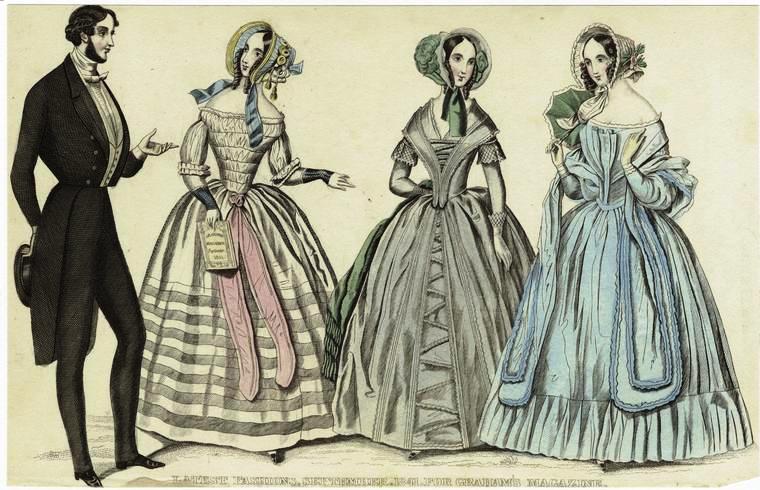
Despite the ever-present confusion and chaos in the political world, the 1840's saw a return to something like simplicity and sanity in fashion. For instance, the astronomically high levels of poof located around the sleeves narrowed down to a slimmer, more natural style, commonly going off the shoulder.

Source
It's a little hard to see in the above picture, but check out the pointed tip of the bodice at the waist. This became very popular very early in the decade (mostly for eveningwear, it looks like), and once it was there, it was there to stay.

Samantha Tuck is my homegirl.
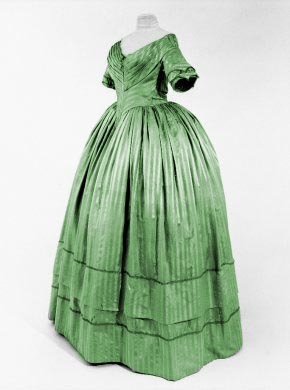
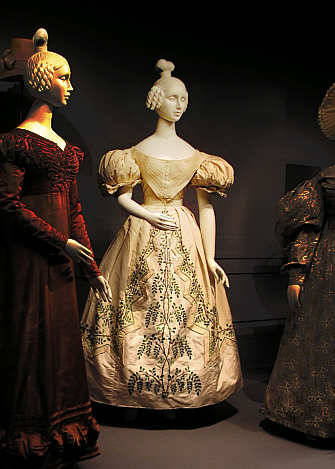
A slight change in the shape of skirts surfaced near the middle of the 1840's. They were slowly gaining volume, from the narrow, natural skirts of the Regency to the conical skirts of the 1830's, and now grew to a bell-shape, making way for the hoop skirts that would come later in the 1850's and 60's.
Source
While it seems like short to elbow-length sleeves are still the norm for evening, and long sleeves are the norm for daywear, it looks to me like colored silk is coming back into fashion for the day, which is something we haven't seen overwhelmingly since the late 1780's - early 1790's.

Gorgeous.
Source
Source
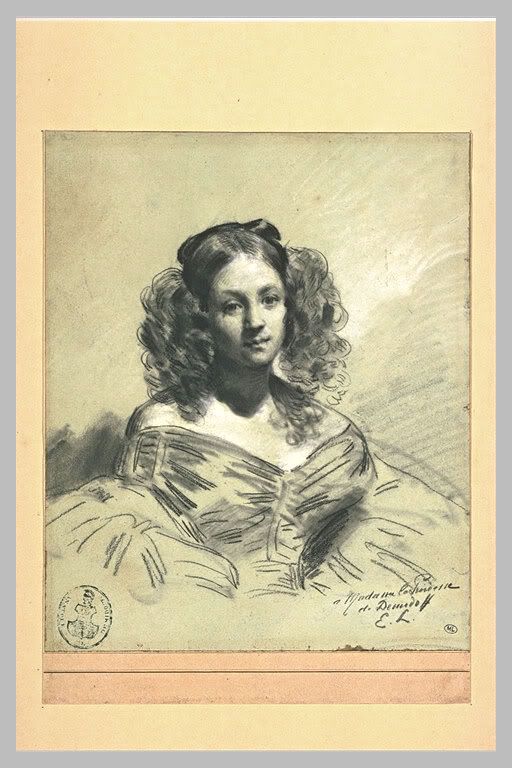
One thing you may have noticed from the first two images in this post is that we have a new hairstyle on our hands. Gone are the wide and tall, accessory-decked curls of the 1830's. During the 1840's, hair was worn parted down the middle and pulled into a bun at the back, with full, long ringlets framing the face. This is sometimes referred to as "spaniel curls."

Source
Source. Check out the off-the-shoulder sleeves in both images.
A slightly fuller version.
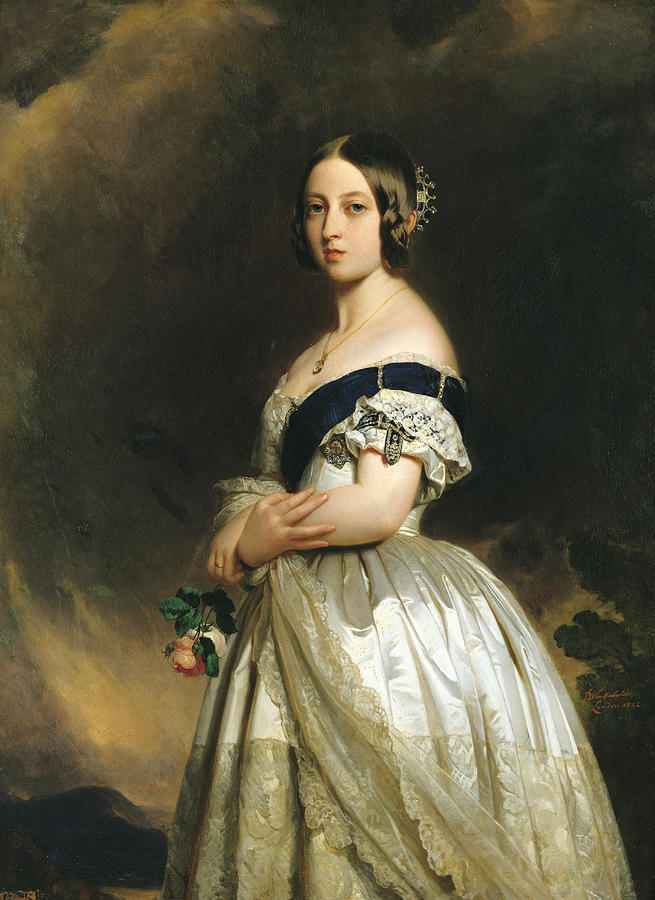
Now this is the fun part. I get to introduce you all to a good friend of mine. His name is Franz Xaver Winterhalter, and he is (was, whatever) the most amazing court painter that ever lived.

Check out the pointed waist, off-the-shoulder sleeves, bell skirt, spaniel curls, and what looks like Spanish lace accents.
Victoria herself.
This is only his early work, you guys. He did portraits of almost every European royal for the latter half of the 19th century, and he only gets better with practice. And most of his subjects are women in gorgeous dresses. Jackpot.

Next week we get a look at the 1850's, a decade full of... well, fullness. The hoop skirt, the bell sleeves, and tiers and patterns galore. Even after a slight return to sense in fashion, the general grandeur of the past few decades in comparison with the simplicity of where we began leaves me in awe of how drastically things can change in 50 years.

See you next week.

Wednesday, July 4, 2012

Inflation- The 1830's

Happy 4th of July! I hope you're enjoying your day. To add to the fun and festivities, I've got a gem of a decade this week: The 1830's!

Source
In the 1830's, everything got bigger. For instance, the US national debt and unemployment rates, under new president Andrew Jackson during the Panic of 1837 (after the former was briefly paid off for the only time in US history). Skirts, sleeves, shoulders, bonnets, and almost every other element of the female wardrobe also enlarged (accounting for my nerd humor in the post title. Sorry, guys, I couldn't resist).

Outside of America, a monumental change took place in the latter part of the decade, the ascension of Queen Victoria to the throne of Great Britain. You heard that right, we're now officially in the Victorian Era.

Source. Anyone else reminded of Molly's tartan dress in "Wives and Daughters"?

Bold patterns, giant sleeves, and full skirts were the norm at the beginning of the decade. That will stay basically the same for the entirety of the 1830's, although the change in sleeves is an interesting thing to watch. Though the sleeves stay freakishly large, the position changes as the decade wears on.

The way I see it, there are four types of sleeves that are common in the decade. First, we have the giant puffs that begin at the shoulder (or a smidge below) and end just below the elbow, with tighter sleeves down to the wrist. Seen above and below.

Source
Next, there are the random bursts of volume near the elbow, flanked by tighter sleeves on the upper and lower arm.

By now, a shoutout to Samantha Tuck is in order.
And another.
Third, we have the narrower sleeves that tend to be a little fuller towards the bottom.

Source
There were a few exceptions, but on the whole, the first style of sleeves was worn during the beginning of the decade, the second in the middle, and the third near the end. Just in case you want to do any historical fashion sleuthing.

Last but not least, we have the short, puffy sleeves popular during the entire decade for evening wear.

Source
Source
Now, I know I made a promise not to blog about undergarments, but I feel like I need to show you the "sleeve plumpers" that made these sleeves work.

Source
Sleeves weren't the only thing that got bigger during the 1830's; the amount of accessories and decoration skyrocketed, creating the image most fashion scholars have of a laughable decade full of ill-advised sartorial choices. Here's one webcomic author's humorous point of view on the decade, and why they chose not to make the costumes in the comic too accurate (also, take a minute to look around the comic. Ada Lovelace and Charles Babbage fight crime in a steampunk alternate universe? Intriguing).

Back to ridiculousness.

Source
The skirts seem to be shortening slightly.
Source

Source
And no commentary on 1830's craziness would be complete without a passing mention of the fabulous Fanny Dorrit.
As seen above, hair styles and accessories went crazy. The taller, the better, and the sheer amount of stuff worn in women's hair is staggering. It's often a subject of animated conversation when we watch "Wives and Daughters." Because honestly.

Cynthia is a superstar.
So, with all of this craziness going on, I have one question. How is it that Sandy Powell, costume designer for "The Young Victoria" managed to make the 1830's look so incredibly beautiful? To see what I'm talking about, check out The Young Victoria page on costumersguide.comThe costumes from "The Young Victoria" make me think that underneath all of the wacky, crazy antics those 1830's ladies were up to, there was a real elegance, and a propensity among women to be unabashedly girly. Sure, it looked pretty silly, but it's also really fun. See you next week.