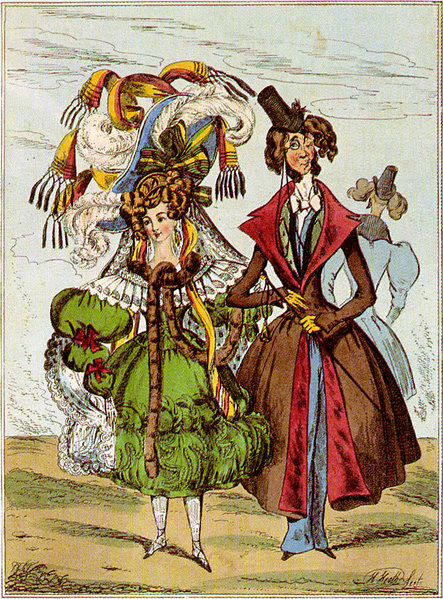
Pages

Showing posts with label 19th century. Show all posts

Monday, December 31, 2012

Fashion in Film: Les Miserables

Hey there! I hope you had a great Christmas and are enjoying the last day of 2012.

Being the theatre nerd that I am, I've been anticipating the film version of "Les Miserables" for months now. I finally saw it the day after Christmas and fell in love with it. It was a beautiful adaptation of both the musical and the book. It had wonderful music, poignant emotions, and of course, brilliant costumes. I knew as soon as I left the theater that I wanted to discuss them, so here we go.

For those of you who don't want spoilers for a 27 year old musical or a 150 year old book, turn back now!

Source
In this post I'm going to cover the three main female characters: Fantine, Cosette, and Eponine. I know, I know, that means no Helena Bonham Carter. But honestly, I don't think this will teach us anything about historical accuracy or character depth. Although I must admit that it is pretty fabulous.

Let's start with Fantine, shall we?

When we first meet Fantine, the year is 1821. The first outfit we see Fantine wearing is her factory uniform, a blue cap and smock.

Source
Under her smock is a pink, empire waisted dress.

Source
Though the empire waistline was declining in popularity by the 1820's (as seen on the dress on the far right), Fantine's dress is probably from an earlier year due to her poverty. I think the color contrast here is interesting. Fantine's pink really pops against the blue of every other factory worker. I think this was done intentionally to further set Fantine apart from her coworkers in this scene.

Another interesting thing to note as we continue looking at Fantine's costumes is that Anne Hathaway recently went completely vegan. That goes for her clothes as well. It's very interesting to see how the costume designer attempted to replicate period textiles without using any animal products. Most of her dresses look cotton to me, but I'm no textile whiz.

As you know, Fantine's fortunes soon take a turn for the worse, and she soon finds herself "at the bottom of the heap."
Source
Sans hair, teeth, and dignity, Fantine appears to be wearing some sort of shift and corset combo. The fingerless gloves point to the ever present winter in the film, which had varying points of success at different parts of the movie. Here I think it works really well. This may be costume analysis overkill, but I think it's interesting how this dress is just a faded version of the same color palate we've seen her wear before: lots of pinks and purples, getting progressively more faded as her downward spiral continues. Here we see her color, or her vibrancy/hope/will to live/what have you almost completely faded away.

Source
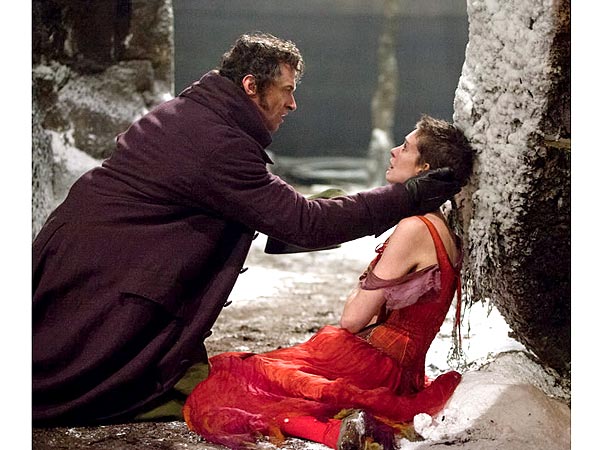
This next costume shows Fantine at rock bottom. It's obviously been a significant amount of time since her descent into prostitution (although evidently not enough time for her hair to grow back), because she's had a wardrobe change into this silky red number. Scarlet was (and still is, in some corners of the world) strongly associated with prostitution, so this color is appropriate for Fantine. The character might have even intentionally chose this color as an advertisement of her profession. One thing that I find interesting about this outfit is the shred of dingy, faded purple at her shoulder. I can't tell if this is what's left of her undergarments from before, but if it is, the symbolism is pretty strong. Fantine's wearing a color that's completely alien to her palate thus far, and only a shred of her own color remains. Again, costume analysis overkill, but the colors do subtly represent Fantine's situation (in my mind, at least).

The last costume we see Fantine wear is a lavender, just-a-little-lower-than-empire waisted dress with long sleeves.

Source
Now, I'm reasonably certain that we've seen this dress on her before, but without another go at the film, I can't be 100% sure. We see glimpses of what appears to be the same dress in promotional images, but I think until I can confirm that it shows up earlier, I'll just treat it like her "ghost" dress.

As you can see, there's not a whole lot to the dress other than the fact that it's lavender. And given the color analysis I've done on past costumes, that's pretty significant. Another interesting point is that her hair is still short. I've seen many stage productions opt to restore Fantine's hair to her in her heavenly form, but it might be a deliberate choice here to keep the hair short. Maybe it's to say that Fantine's hardship shouldn't be ignored or undone. Or maybe it's just because Anne Hathaway actually cut her hair and couldn't magically have it back for this scene.

Let's move on to Eponine.

Source
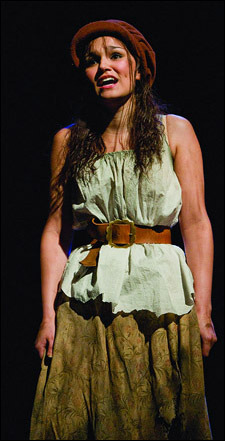
Eponine's first costume for the film consists of a brown skirt (probably with a petticoat or two underneath, given the volume), some sort of green top, and a green scarf/shawl tucked into a thick belt. Compared with the costume Samantha Barks wore when playing the role onstage (which is literally her "boy" outfit with some pants and without the coat), this costume is very feminine. I really appreciate that choice to show off Eponine's femininity, rather than make her a rough-and-tumble foil for Cosette. Yes, Eponine's very tough, but she's still a girl.

That is, until she puts on a disguise and becomes a boy.

Source
This is another great costume, especially when compared to stage versions of the same transformation, in which Eponine simply puts on a coat, some pants, and a hat (without even tucking her hair in) and magically becomes a boy. This is a much more believable getup (which may be why Marius doesn't recognize her immediately like he does in the show). I like that the scarf and belt she's wearing appear to be the same pieces from before. The transformation from feminine to masculine is much more distinct here than it has been on stage, and I think the designer pulled it off very well.

Last, but certainly not least, we have Cosette, who certainly brings it in the fashion department.

Source
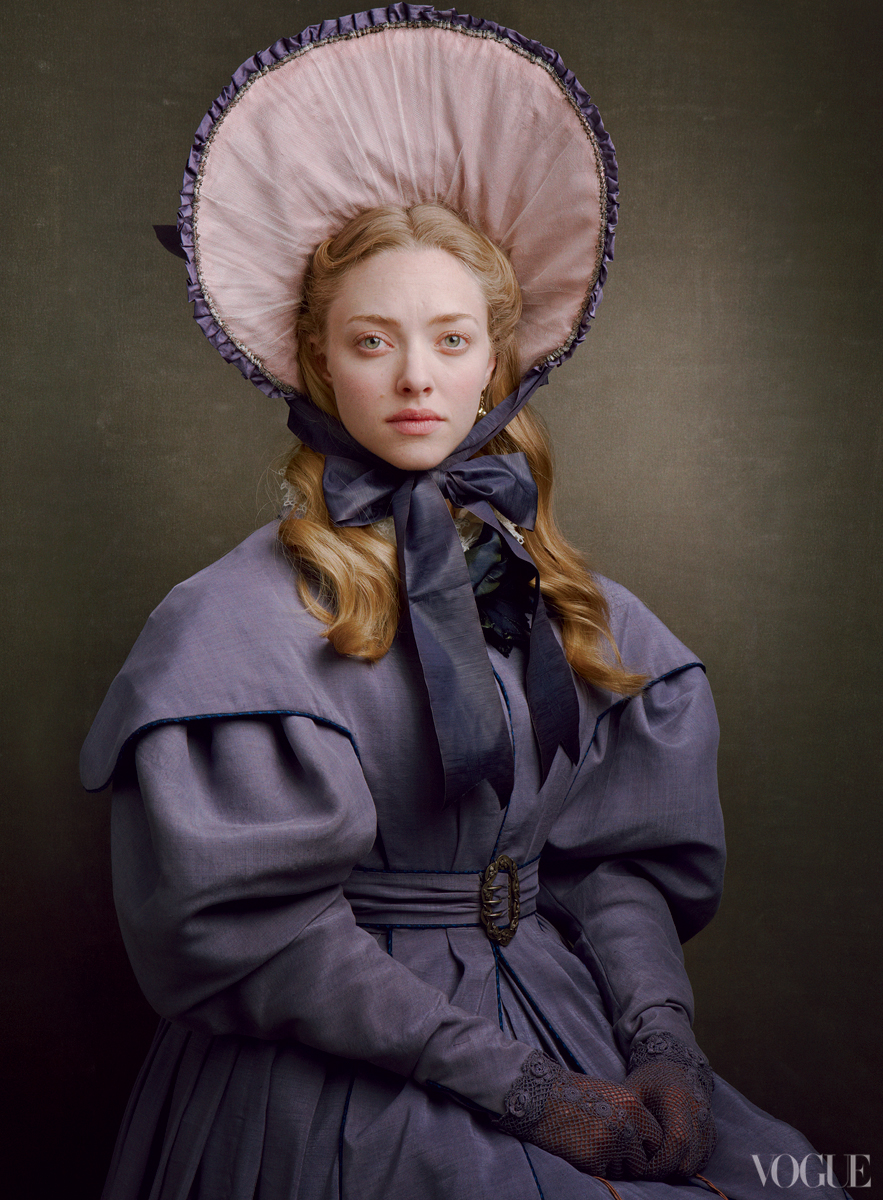
This first dress worn by Cosette could be a subtle homage to the traditional black and white dress worn by Cosette onstage. While it's the definition of 1830's fabulous with huge puffed sleeves and tons of girly accessories, it's also significantly simpler than most dresses of that opulent decade. Crazy prints with fussy ribbon trims were all but mandatory in the 1830's, but Cosette only wears one printed dress (maybe two?) over the course of the film, and it's a subtle print at that.

Source
I think this shows how pure Cosette is, for lack of a better word. In the entire story, Cosette is the bright spot in a sea of darkness, untainted by the misery that surrounds her. And to some extent, her clothes are the same way. When the world around her is going absolutely crazy, Cosette stays simple, sweet, and pure.

Another great costume worn by Cosette is her wedding gown.

Source
Well, the first thing I notice about Cosette's dress is that it's white, even though "Les Miserables" is a pre-Victorian story. As I've discussed before, this isn't a complete inaccuracy, and it shows the innocence and the purity of the character well. I'm very puzzled by the panel on the front of the dress. I don't remember it from seeing the film, and I certainly don't think the designer would do this, but in the lighting of this photograph, it looks sheer. I'm not entirely sure what it is in reality, but if there's something that does not show the innocence and purity of the character, that would be it. Another interesting thing here is that this is the only time we see Cosette with her hair up. I think this shows her coming of age in a way, her passage from childhood to womanhood.

Source
Well, that wraps up my costume analysis of "Les Miserables." I really, really enjoyed the film, and I heartily recommend it whether you're a long time fan of the musical and/or book, or you're just looking for a way to spend three hours and shed several million tears.

Huge props to Paco Delgado, the costume designer for the film.

Wednesday, November 21, 2012

Fashion in Film: Pride and Prejudice

I'm sure you're familiar with the story of Pride and Prejudice. Even if you've never read it or seen an adaptation, the story is a huge part of our culture. It's the ultimate classic novel, and by extension, the ultimate costume drama.

When I say "the ultimate costume drama," I'm of course referring to the 1995 adaptation, in all its five-hour, Colin Firth-y glory. My mom was the one who got me started on this adaptation when I was just a wee child. I've since seen it upwards of twenty times. Not to toot my own horn, but I can also quote pretty much every scene word-for-word. It's the film that got me started on Jane Austen, and it's been a big part of my life for a long time. It's our feel-good movie. Whenever we're having a bad day, we pop in the disc and watch an hour of it here or there. It doesn't even matter whether we watch it in order or not. We're sucked into the beautiful story every time.

So, without further adieu, let's take a look at the costumes worn by that singular, indefatigable, beloved Austen heroine, Elizabeth Bennet.

Source
If you're a fan of reading IMDb trivia pages like I am, you'll know that the BBC loves to reuse costumes. The page for pretty much every British period drama has a piece of trivia that reads like this:

The green striped gown with velvet Spencer jacket Anna Chancellor (Caroline Bingley) wears at Netherfield Hall is the same costume worn by Julia Davis (Elizabeth Elliot) at Kellynch Hall in PersuasionVicki Pepperdine (Ann Dobbin) in the park scenes in Vanity Fair, and an extra at the London party where Annabella Milbanke meets Byron in Byron. The Spencer also appears, without the striped gown, in Little Dorrit, worn by Emma Pierson as Fanny Dorrit. 

 This means that several of the costume pieces in Pride and Prejudice weren't built specifically for the production. The real design of the costume lies in how the designer selects, matches, and styles the various pieces. Let's take a look.

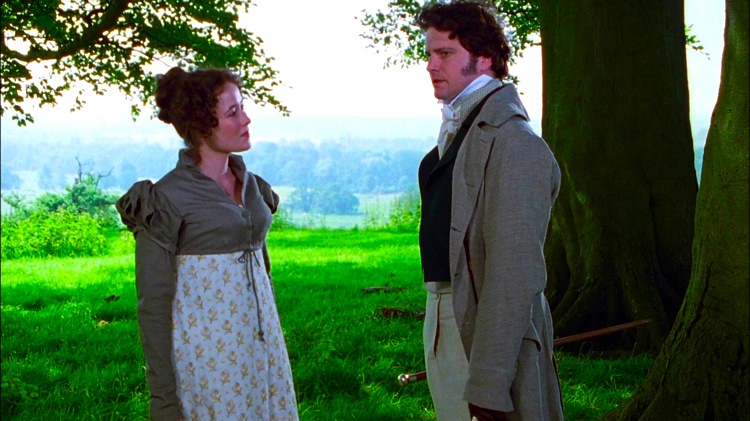
The first time we meet Lizzy is when she's on a walk near her home. She's wearing a simple day dress, a structured spencer jacket, and a bonnet. This scene and her outfit set the tone for her character- she's outdoorsy, adventurous, and free-spirited, but still sensible and put-together. Lizzy's costumes, unlike those worn by the ladies around her, aren't fussy in the least. This sets her apart from the other women and shows her independent nature. We'll see several variations on the dress, spencer, and bonnet combo as the story progresses.

Source
I especially love this pelisse.
Source
Elizabeth's day dresses are equally simple. They're usually white or have some sort of subtle pattern (as seen in the image above), and they show her no-nonsense personality well. Check out the image below and compare Lizzy with the rest of her sisters. She's the only one who isn't wearing a pattern, and her dress is a demure cream color.

Source
One of Elizabeth's more elaborate day dresses is also my favorite. The coral dress she wears at Netherfield is one of my favorite Regency costumes of all time. The cheery color compliments her well, and it's very vibrant compared to the rest of her relatively tame wardrobe.

Source
Of course, no analysis of Elizabeth's costumes would be complete without the iconic white ballgown that she wears at the Netherfield ball.

Source
This is pretty much your textbook Regency era ballgown. White was a popular color for young women because it looked great in candlelight. The short sleeves and gloves line up with both the fashion and the etiquette of the time. The one thing that makes this outfit stand out is her floral ribbon crown. Yet again, we see something that's beautiful in its simplicity, and some very smart fashion choices on Lizzy's part.

To round it all out, we have the final scene of the mammoth drama, in which Lizzy and Darcy get married.

Source
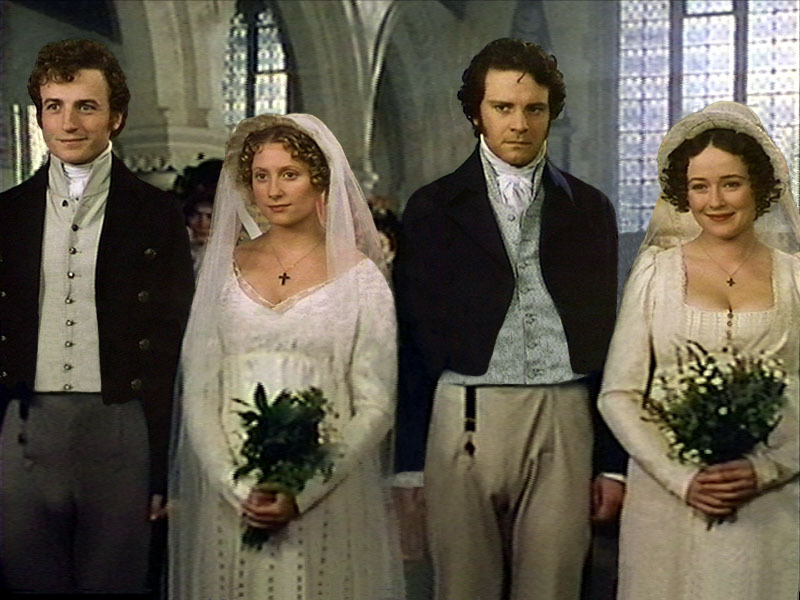
It looks like Lizzy's wearing a long-sleeved white gown with pleating and buttons on the bodice, and some sort of white pelisse on top. Elizabeth and Jane are both wearing white, which I've touched on before, and it's interesting to see how both of their wedding gowns express their personalities. Elizabeth's is simple and structured, while Jane's has demure lace accents and a more feminine cut.

Source
That wraps up this week's Fashion in Film post! It's been so fun to write about one of my family's favorite films, especially on the day before Thanksgiving. I hope you have a lovely holiday, and I'll see you next week. God bless.

Bonus Round: Check out this amazing analysis of different adaptations of the Netherfield ball. It has some great info on Regency era fashion and ballroom etiquette.

Wednesday, November 7, 2012

Fashion in Film: Gaslight

I have a confession. Despite my love for classic film, I have yet to see Casablanca. Criminal, I know. As it stands at the moment, my favorite Ingrid Bergman movie is the 1944 adaptation of the play Gaslight. The film features a genius psychological plot, a twisted romance, and Joseph Cotten before I saw him in Shadow of a Doubt and became terrified of him. The movie is set in the year 1880, and in the interest of full disclosure, a big reason why I like the film so much is because of the amazing, late Victorian costumes. Let's jump right in.

Source

Near the beginning of the film, Paula's costumes are youthful, with whimsical details such as lace, flowers, and ruffles. This costume we see below is a white or pastel walking dress with a high, ruffled collar and lace accents. The hat is by far the centerpiece of the outfit, with flowers and floral lace covering it entirely.

Source
Another costume from a little earlier in the film is a suit that Paula wears when she first returns to the house where her aunt was murdered years ago.

Source

Source
From the above picture, we can see that this dress has a princess bodice that ends well below the hips. The lack of bustle lends itself well to the early 1880's. The color is a light tan with an ombre effect on the ruffles of the skirt. The neck kerchief and ruffled hem make it fun, but the structure and smart buttons make it a little more mature than the lace-and-flower extravaganza we saw before. Not that I have anything against lace, flowers, and ruffles, but it does seem like the costume designer is trying to show Paula's youthfulness and innocence, or perhaps how she hasn't moved on from the traumatic event that happened in her childhood.

Paula's costumes go downhill as quickly as her marriage and peace of mind do. She goes from feminine, put-together suits to dark, simple dresses, and eventually wears a loose-fitting suit that looks like little more than a housecoat. 

Source
Source. Her hair also seems to be slightly mussed here.
I think this sliding scale from dainty to disheveled shows the corruption of Paula's innocence. At the beginning of the film, Paula is energetic, optimistic, and seems to finally be healing after the tragedy that struck her family. As we near the film's climax, we see her become paranoid, bitter, and broken-spirited as she doubts the man she loves and her own mind.

Source

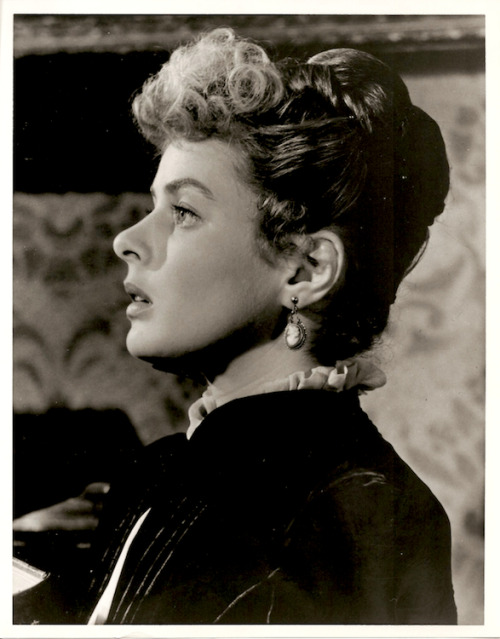
Paula's hair is one of my favorite elements of the character's style. It's textbook 1880's, with frizzled bangs in front of a high bun.

Source. Love the cameo earrings.

My favorite costume in the film is the evening gown Paula wears to a party late in the story. Despite her increasingly haggard appearance at home, she cleans up very nicely. Perhaps this is because of how hard she had to fight for the social interaction she's been denied for several months. If you only leave your house once every few months, I guess you've got to look your best.

Source
The dress is a spot-on example of early 1880's evening wear, with a low neckline, thin sleeves, no bustle, a gathered overskirt, and a respectable train. The floral trim near the hem is gorgeous.

Source
In the above photo, we get a better look at her accessories. It looks like she's sporting a gorgeous brooch, with a matching flower-and-pearl piece in her hair. A thin choker also seems to be involved.

Source
Is it just me, or does this light, decadent gown feel like kind of a throwback to the costumes Paula wore earlier in the movie? To me, this shows how Paula is striving to regain the normalcy she lost.

The attempt was valiant, but unsuccessful. Paula immediately goes back to her dark robes and dark thoughts. But as the film draws to a close, it's interesting to see how Paula manages to compose herself when facing the man who's been torturing her all this time. The black, scalloped suit seems more fitted than before (perhaps because she's wearing it closed now? I can't be sure), and her hair is once again perfectly in place.

Source
I won't spoil the ending, but I will say that by the film's close, Paula is decided, strong, and very much in her right mind. This last costume shows this very well. 

Paula's costumes in Gaslight reflect the themes of the film itself: destroyed innocence, deterioration, and restoration. Gaslight is a lovely, thought-provoking piece of classic film, and it's definitely worth a watch.

Source
Bonus Round: Check out this gallery of Angela Lansbury's character in the film. Her fun, flamboyant costumes (when she's not wearing her maid's uniform) show the character's conniving, attention-seeking nature. Plus, it's just really neat to see a young Angela Lansbury.
Bonus Bonus Round: When looking for sources for this post, I happened upon this auction of Debbie Reynolds' Hollywood memorabilia collection (from whence I got the color photo of Paula's suit from the beginning of the movie). It contains hundreds of iconic costume pieces from different movies, and it made my nerdy heart skip a beat.

Wednesday, October 31, 2012

Fashion in Film: Little Dorrit

The 2008 adaptation of Little Dorrit is one of my favorite Charles Dickens adaptations of all time (tied with Bleak House). One of the really interesting parts of the series is the contrast between Amy Dorrit, the title character, and her sister Fanny. Meek, sweet, responsible Amy couldn't be more different from her flamboyant, outspoken, domineering sister. These differences are reflected in her costumes.

Warning, this analysis contains spoilers for Little Dorrit. Tread with caution!

Source
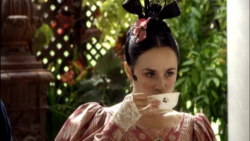
Little Dorrit is a rags-to-riches-to-rags-to-riches story, and at the beginning of the series, we see the Dorrit family decidedly in the rag category. For the majority of the series, Amy wears the same striped purple dress with an apron pinned onto the front.

Source
The book and film are set in the late 1820's. Though Amy's dress shown above is by no means fashionable, the natural waistline and full sleeves show the time period well. 

When she's outside her home at the Marshalsea debtor's prison, Amy pairs this dress with a simple cape and a dated straw bonnet.

I don't believe her bangs are too period accurate, but they show the character's sweetness and shyness well.
Fanny isn't too involved in her sister's life near the beginning of the story, so we don't see her too often. The few times she does appear, she's wearing clothes with bright colors and ornate details, and bold makeup that fits her occupation as a showgirl.

Source
I think it's interesting that the first outfit we see Fanny wearing is very detailed and showy, but made out of some sort of worn imitation velvet. 

Amy and Fanny's lives change dramatically when it's discovered that the Dorrit family is actually entitled to a large sum of money. Of course, Fanny and Edward (Amy and Fanny's brother, played by Arthur Darvill of Doctor Who fame) move back in, and the entire family sets off for Italy.

Of course, the Dorrit family spares no expense when buying their new wardrobe, and both girls wear gowns that feature expensive material, fashionable construction, and intricate detail.

When the two sisters actually start wearing more than one outfit, it becomes evident that both of them wear certain colors very often. Amy wears a purple gown in every scene but one (when she's wearing black in mourning for her father), and Fanny tends to wear a lot of green (although not exclusively). 

Source
Though they have a significantly larger amount of money by this point in the series, Amy and Fanny's personalities show through in their clothing in much the same way as when they were poor. Amy still prefers to keep her wardrobe very simple, with minimal details on her gowns.

Her dress is a very light shade of purple, but purple nonetheless.
Meanwhile, Fanny throws caution to the wind, and her sense of style is only heightened by wealth. Her style becomes a strange mix of the past and present; though she wears dresses with fashionably voluminous sleeves and tons of decoration, and her hair has the distinctive, wacky loops that hint towards the 1830's, she continues to sport her showgirl makeup. Of course, makeup really wasn't socially acceptable until the 1920's, so I think this says something interesting about Fanny's character. More on that later.

Source
Let's play a game of compare and contrast with Amy and Fanny. Take a look at this photo below.

I see you creeping back there, Arthur Darvill.
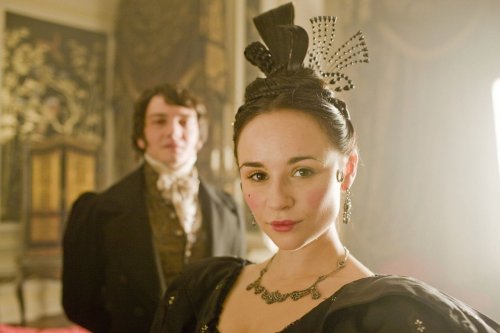
First, we see that both Amy and Fanny are wearing their customary colors, purple and green. Their gowns are very similar in cut, with the natural waist line, structured bodice, and puffy sleeves of the late 1820's. Both of them wear simple necklaces and fingerless lace gloves. And that's pretty much where the similarities end. Amy's dress is a simple satin with a buckle on the waistband, whereas Fanny's gown is decked out in lace trim.

The hair is another interesting point of contrast. Of course, my eye is immediately drawn to Fanny's peacock feather extravaganza (very 1830's), but Amy's tiny attempts at hair loops are also very interesting. She's trying to follow the fashion, but is very timid about it. Meanwhile, Fanny is pulling out all the stops (which might say something about each girl's attitude towards their new lifestyle). Another interesting point about the hair is the part that frames each girl's face. Fanny's hair is severely pulled back from her face, with one curl intentionally plastered to her temple. Amy's hair is more natural, with lighter curls framing her face and neck.

Not to draw attention to anything inappropriate, but Fanny's neckline is significantly lower than Amy's, which was actually rather unfashionable for the time. Necklines on evening dresses really didn't get that low until the early 1840's, over ten years later. This paired with Fanny's makeup tells me that Fanny still yearns for her showgirl days. Although she claims to want to leave the past behind her, her wardrobe tells a different tale.

All good things must come to an end, the Dorrits' wealth included. When Mr. Merdle (the Bernie Madoff of the 19th century) commits suicide because of his unraveling financial scam, the Dorrits lose all of their investments and are sent back to poverty. Well, Amy is. Fanny has escaped the clutches of financial insecurity by marrying Edmund Sparkler, Mr. Merdle's flamboyant stepson.

Source
In the picture above, Fanny is in mourning, both for her father (who died while the Dorrits were still wealthy) and her father-in-law. That doesn't seem to phase her, because we still see her in bright makeup, jewels, and with her crazy, fabulous hair loops perfectly intact.

Amy stays with her sister and the in-laws for a while, but understandably grows weary of it. When she goes to help a friend (or more than a friend? Perhaps, it's too lengthy to explain here, the story has a... Dickensian amount of characters and plot lines) who has found himself in the Marshalsea, she is most likely in half mourning, and so her purple-wearing tendencies are justified.

Source
Amy's choice of clothing here is very simple. Her dress is dark, structured, and tailored well, and her sleeves are almost unfashionably slim. She's back to wearing her hair with straight bangs, and her bonnet simply matches the dress, with no more fuss required. Though it's very basic, this costume feels very strong to me, and it's more mature than the girlish things Amy's worn up until this point. It shows her character change well. She goes from a young, shy seamstress who is nicknamed "Little Dorrit," to a determined woman who has seen her share of sorrows and has the courage to soldier on.

Another interesting point for comparison and contrast is that both sisters get married at different points in the series: Fanny (as mentioned above) to Edmund Sparkler, and Amy to... someone else. I'll keep one spoiler unspoiled for you.

I would like to call attention to Edmund's face.
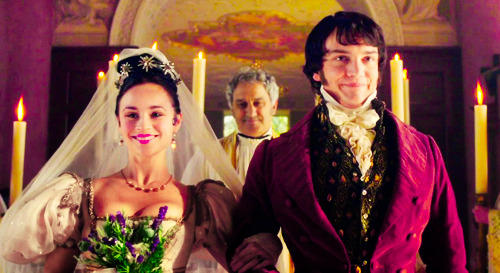
Although we don't see much of Fanny's dress in this brief shot, it is pretty clear that her personality is just as present on her wedding day as it is in every other scene. Makeup? Check. Expensive details? Check (in the form of the gold embroidery trim). Low neckline? Check. Jewels? Check. Enormous pillow-sleeves? Check. The only thing that's missing is a crazy hairdo, which is replaced by a starburst tiara. Also, I have to say, I'm in love with the way she draped her veil over her massive sleeves.

Now, you may be asking yourself, "Why is Fanny wearing white? Queen Victoria hasn't gotten married at this point, and Queen Victoria started the tradition of white bridal gowns." Well, the short answer is that this (semi) anachronism pops up in a lot of period films. Modern audiences want to see brides wearing white. It's just our thing. However, Her Majesty wasn't the first bride in the universe to wear white. She did popularize it, but many ladies' magazines prior to the Victorian Era advised brides to wear white because of its connotations with purity. In Fanny's case, that's pretty ironic.

Source
Amy's wedding look is much more typical of the average pre-Victorian bride. Like most women of the time, Amy is simply wearing the best dress she owns, which appears to be the purple evening gown from before. She pairs it with her lace gloves, a lace veil, and plenty of flowers (purple, of course) in her hand and hair.

The way Amy wears her hair is really interesting to me. She's got this totally off-the-wall curly side ponytail thing going on, and still manages to work in her trademark bangs. This looks like it's more of a character development thing and less of an actual historical hairstyle. To me, it shows how Amy has blossomed as a woman, (partially loose hair, flowers) but still retains her old sweetness (bangs).

Amy and Fanny couldn't be more different, and that's masterfully shown in the series. I heartily recommend Masterpiece Classic's adaptation of Little Dorrit. Trust me, I haven't spoiled even a fraction of the massive, beautiful story. See you next week.

Sunday, September 23, 2012

1890's Fashion on Doctor Who

So, if you follow me on Pinterest, you've probably noticed by now that I'm a massive fan of the British sci-fi show Doctor Who. I love a lot of things about the show, but one thing that really bothers me is that the Doctor and his companions seldom dress to suit the time period they're visiting. This often results in a merry jaunt through Shakespeare's London or the Old West wearing jeans, t-shirts, tweed, and bow ties. And while it does bum me out a little bit as an historical fashion devotee, as a fan of the show I've gotten used to it.

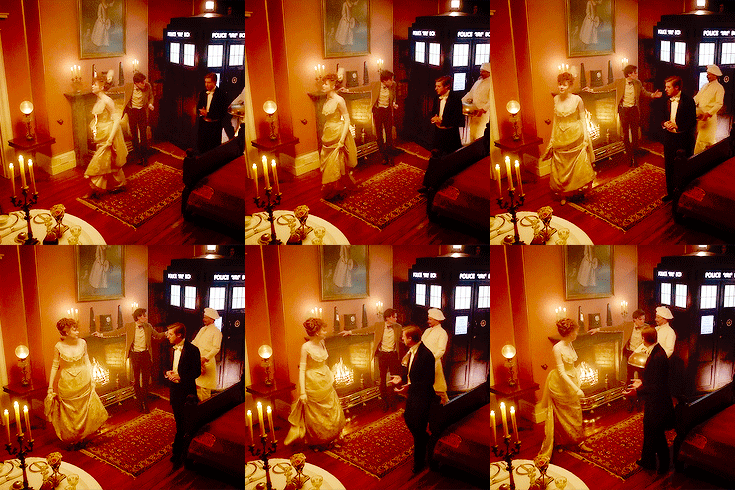
But then last night, during the newest episode of Series 7, "The Power of Three," the BBC gave me a little gift. Without spoiling too much, there's a (very brief) scene in which the Doctor takes Amy and Rory to the Savoy Hotel in 1890 for their wedding anniversary. And they step out of the TARDIS in period dress.

(All images from the Official Doctor Who Tumblr)


Amy's gown is a textbook example of evening wear in the late 1880's-early 1890's, with a pointed waistline, thin, strap-like sleeves, a low neckline, and a narrow skirt with slight bustling in the back. Even her hairstyle is accurate, with frizzled bangs and a high, curly bun.

My reaction was something like this.


It doesn't happen often, but I really do love it when period costumes make an appearance on Doctor Who. I've seen some evidence that we may have more late Victorian garb on the show in the near future. Stay tuned.