Pages

Wednesday, September 19, 2012

Keep Calm and Carry On- The 1940's

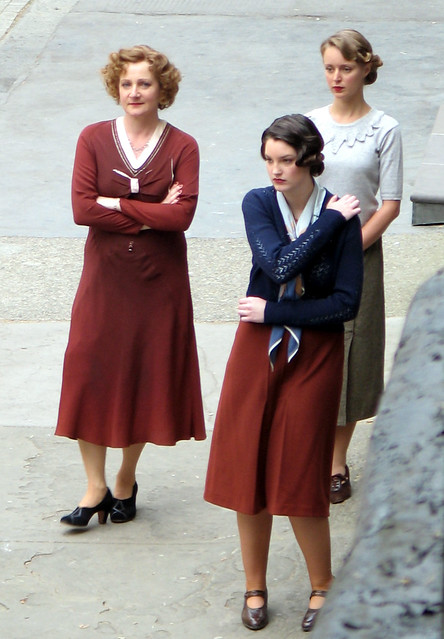
In 1939, the world was once again thrown into war when Britain and France (along with smaller countries of the British Commonwealth) declared war on Nazi Germany after Germany invaded Poland. The war lasted for six years, finally ending on September 2nd, 1945, just a day after its six-year anniversary. Once again, women were called to the workforce in the absence of men, perhaps even more so than during World War I. In several allied countries (and in Axis countries as well), it was one's patriotic duty to do something, anything for the war effort. Women's clothing of the decade reflects this with simple, sturdy cuts and textiles made for years of work and wear.

Now, I'm like the majority of people in that when I think of the 1940's, I think of World War Two. It's unavoidable that the war was a defining event of the decade. But now that it's time to look at the 1940's as a whole, I can't help but wonder, how did fashion change in the five years after the war? Let's find out.


Let's start with the World War Two years and work our way to the end of the decade. By 1940, Europe was already a year into the war, and in the early years of the decade, most of the Western World rationed fabric, as well as completely requisitioning all silk and nylon for military purposes. Women entered the workforce in the place of their absent husbands, brothers, fathers, and sons, and those in more hands-on jobs began to wear trousers out of necessity.

Source
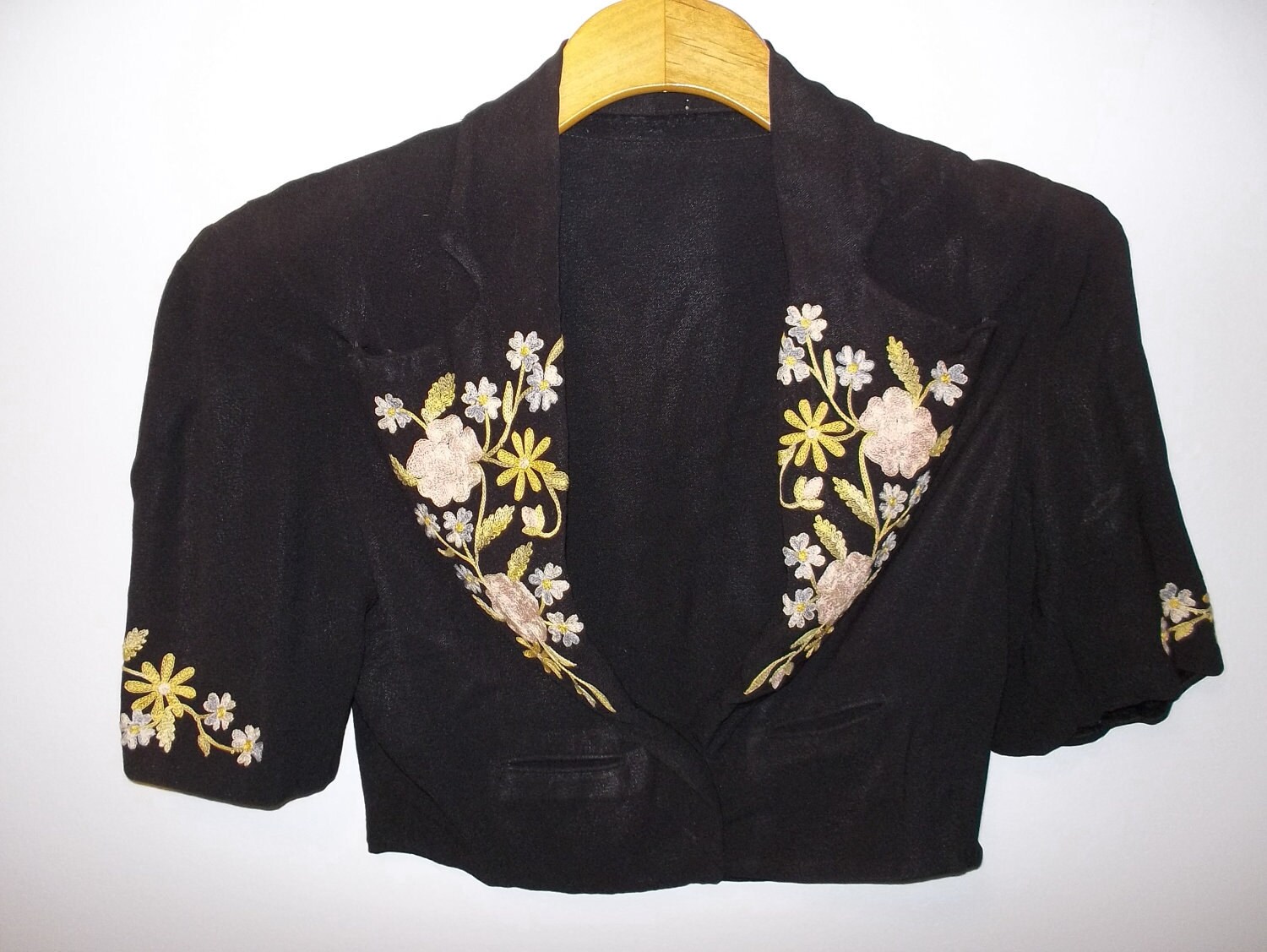
Those who didn't don a welder's helmet or a mechanic's coverall sported simple silhouettes with squared off shoulders, skirts just below the knee, and modest, unobtrusive colors.

Source
Source. This collar was very popular during wartime.
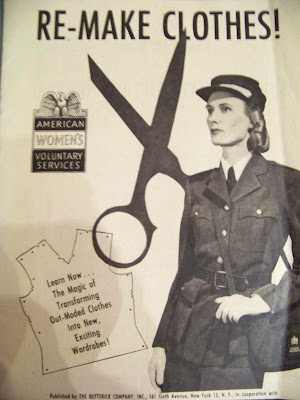
According to Wikipedia, several fashion magazines gave instructions on how to remake men's suits into women's outfits. After all, they were just hanging in the closet, and it was free fabric. The government encouraged reusing clothing with slogans such as "Use it up, wear it out, make it do!" and "Make do and mend."

Source
In addition to dresses and suits, trousers were carrying over into the fashion world (but they wouldn't be widely received until the 1950's). Vests, skirts, and blouses were also popular.

Source
 The war finally ended in 1945, and the wheels of fashionable progress were turning once again. In 1947, Christian Dior released a style of dress that was dubbed "The New Look." These dresses foreshadowed the 1950's, with longer, fuller skirts, accentuated tiny waists, and full busts. To top it all off, Dior used an exorbitant amount of fabric to create these new dresses, which was a far cry from the strictly rationed fabric of the first half of the decade. Luxury fabrics like silk and colors also came back in full force, almost like a celebration of victory and the joy of being on the other side of the worst war the world had ever seen.

Source
Source. Very I Love Lucy.
Source
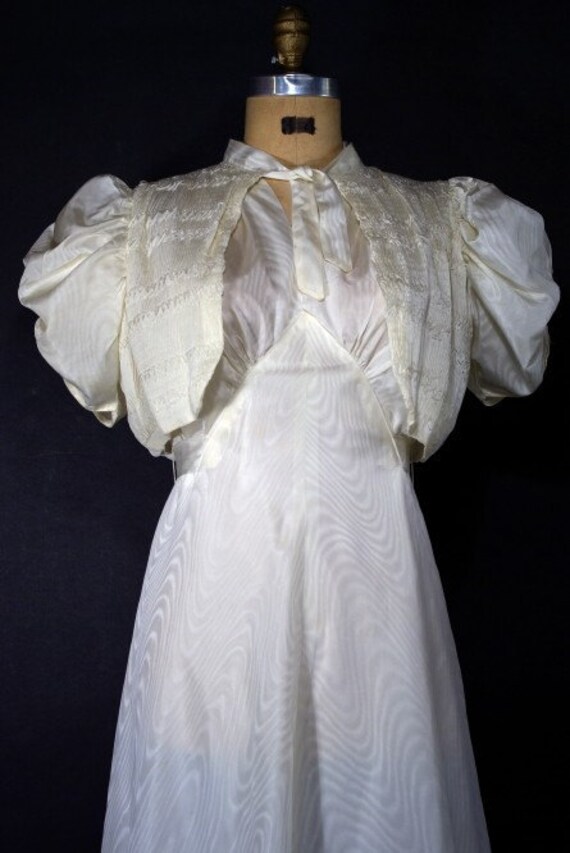
Evening wear was also revolutionized in 1947 , when strapless dresses with long, full skirts and plenty of decoration and details first hit the runways.

Source
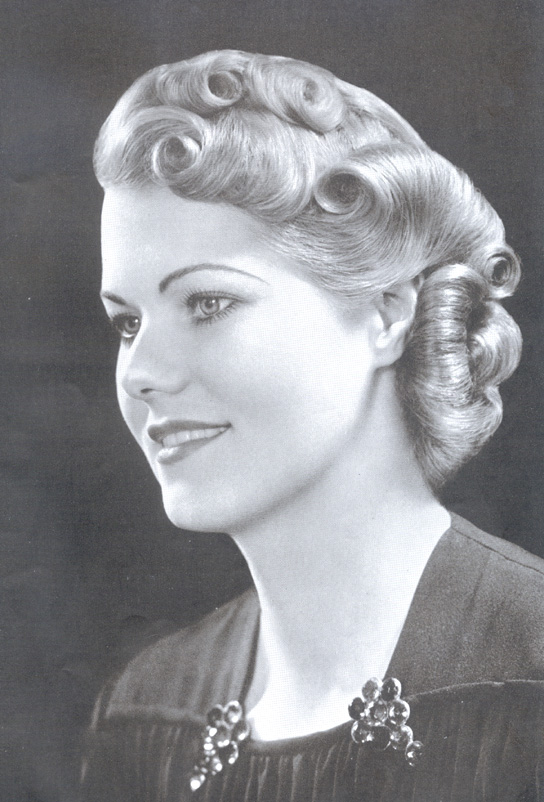
Hair was commonly worn in shoulder-length curls, with popular "victory rolls" on the top of the head, or waved bangs framing the face, or low buns at the nape of the neck with pin curls. Women experimented with intricate hairstyles that all had one thing in common: lots and lots of curl.

Source
Source
Source
Source
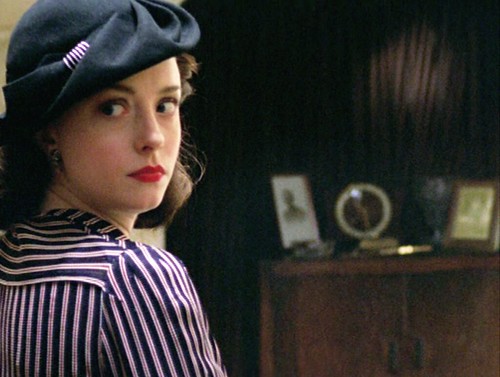
Hats were much like those of the 30's, medium-sized, with creative decorations and worn at a jaunty angle. While everything else during World War Two remained simple due to rationing, the materials used in hats were not rationed, so milliners continued to make them fancy and fun. Here's a WONDERFUL article on hats during World War Two.

Source
Next week, we'll take a look at the 1950's, the Golden Age of Hollywood and (for those of you keeping score at home) the last installment of this leg of the Decade Wednesday journey. Tune in next week for the dramatic conclusion! Until then, flip through a LIFE magazine from 1942, and experience World War Two in real time. See you next week!

Monday, September 17, 2012

User Error! (+ links)

You saw nothing just now.

That was not the Decade Wednesday post you were looking for.
Source
Just a quick explanation for any of you that may have seen this week's Decade Wednesday post a bit early. Chalk it up to my absentmindedness. ;) Hope you enjoyed the preview. If you didn't catch my slip of scheduling, have some links to tide you over until Wednesday.

This fun site has several Regency themed generators such as character names, romance novel plots, and names for estates.

Foyle's War is coming back. I'm a huge fan of the show, but I'm a little apprehensive about this new series (set to air in 2013). After seeing Series 7, I'm rather of the opinion that the show should have ended when the war did. Still, I can't help but be a little excited that we'll get to see Michael Kitchen and Honeysuckle Weeks puttering around in 40's-50's England again.

One of my favorite websites, ImprovEverywhere.com, has two missions involving people impersonating historical figures (specifically Anton Chekov and King Philip IV of Spain) in public places. Hilarity ensues. Just a tip, though, don't click on the witness account of the Anton Chekov Improv, it gets a little rough. ;)

Hapy a lovely week!

Wednesday, September 12, 2012

In Which Designers have a Field Day- the 1930's

Last week in the 1920's, we had straight, tunic-like dresses that were meant to disguise a woman's figure. In the 1930's, we see a return to structure and tailoring in garments, with emphasis on the shoulders and waist. The film industry and celebrities also began to influence fashion for the first time, and vice versa. "Let's poke it with a stick."

Source
In the late 1920's, long skirts were coming back into fashion. Designers eased back into them, and by the 1930's, they had lowered from just below the knee to just above the ankle.

Bette Davis.
The skirts on most evening gowns went back to floor-length.

Source
Shoulders became a focal point of both day and evening dresses. Volume was the important thing, not how it was achieved. Designers experimented with different ways to get that added poof.

Source
Source
Source
The most common way to accentuate the shoulders was to have lighter fabrics that were loose around the shoulders so that they fluttered out (seen above).

As I mentioned before, waistlines came back into existence and cinched in at the natural waist.

An evening wear example
And an (upscale) afternoon example. Check out the birds, I love them.

In addition to focusing on the natural waist, several dresses and jackets emphasized the empire waist.

Source
Source
It seems to me that this was really a time for experimentation as far as textiles and embellishments go. Though chiffon and other light fabrics were popular, I've seen a veritable smorgasbord of different fabrics used in different ways.

Source

Source
Source
Source

The short bobs of the 1920's remained popular during the entirety of the 1930's. For those who opted to keep their hair long, buns were worn at the back of the head or the nape of the neck, with curls that foreshadowed the 1940's.

Source
Cloches stayed popular until the early-mid 1930's, when they were replaced by small hats that usually tilted over the forehead at an angle.

Source
As one last shout out, I've been watching a lot of David Suchet's Poirot adaptations lately, which (in addition to being brilliant adaptations of Agatha Christie's novels and short stories) really showcase the fashion, art, and architecture of the mid 1930's.

Gorgeous.
Also gorgeous.
At the end of the 1930's, World War II broke out in Europe, which will lead us into next week's look at the 1940's. Once again, we'll see a near stand still of fashion progress (like in the Regency Era due to the Napoleonic Wars), and a return to simplicity that always comes around by necessity during wartime.

Wednesday, September 5, 2012

"Everything Today is Thoroughly Modern"- the 1920's

Though I don't consider myself anything close to an expert, I do feel like I know more about 1920's fashion than any other time in history (perhaps with the exception of the Regency Era). It's been a 20's filled year for me, and for lots of other people as well. Aside from my own work both as a costume designer and an actor on various 20's projects, The Artist, a film done in the style of silent movies, won the Academy Award for Best Picture, and this spring, the runways were filled with art deco-inspired designs.

Source
So why this fascination with the 1920's? Despite the fact that the fashion is nearly 100 years old, flapper styles still reflect change, and the fresh novelty of new freedoms. Women had the right to vote, the world was on the other end of the biggest war they had ever seen, and the modern age had begun. Cue several hundred references to Thoroughly Modern Millie.

Source
You've probably noticed that my Decade Wednesday posts up to this point have been very formulaic. Take a look at the skirts, bodice, sleeves, textiles, and hairstyles. Note the differences between day and evening wear. But now that the modern era of fashion has begun, it's harder to do that. Women began to wear more suits and separates as they entered the workplace in droves. There was more variety in fashion than ever before, ranging from feminine, lacy dresses that were reminiscent of pre-war styles to sharp edges, bold colors, and scandalously short skirts.

Perhaps the most recognizable trait of 1920's clothing is the long, loose, straight lines that came after the tight corseting women had known their whole lives.

Source
Second to that are the new, shorter skirts.

Source
Evening dresses on the whole had the same sleeveless, moderately low neckline and mid-length skirts (although some high fashion couturiers played with lengths and sleeves).

Source
A stunning early decade wedding dress.
Though the long, straight silhouette remained the same for both day and night (with a few notable fuller-skirted exceptions called robes de style, seen here), day wear had the addition of sleeves and collars, both for suits and suit-like dresses.

Source
If a dress could be said to have any waist at all, it was very low, well below the hips.

Source
This was all to enhance the new idea of womanly beauty: emulating men as much as possible. That's not to say that women suddenly took to cross dressing, but straight lines that minimized curves and short haircuts were very much in fashion. Coats did this as well as garments, effectively hiding the wearer under folds of warm, bulky cloth.

Looks comfy.


Though a boyish silhouette was popular, garments themselves were far from masculine. After a brief hiatus during the first World War, lace, floral accents, furs, bows, and feathers were back in full force. Oh, and did I mention beads? Everything a woman wore in the evening from gowns to headpieces were dripping in beads. And it was glorious.

Source
Source
Source
Source
Chiffon was a popular fabric for evening wear, and it moved beautifully with the lively new dances of the time.

Source
 By the 1920's, bobbed hair was widely accepted. Two versions of the bob existed, a very sleek, mature look, sometimes with bangs, and a curlier, more youthful style, often accomplished with a technique called a finger wave.

Source
Source
Hats were very fitted over the head and very close to the face, forming the cloche look that's iconic of the 1920's and 30's. I once read that hats were meant to be worn very low on the forehead, so that the only way a woman could see would be to tilt her head up and look down her nose.

Source
By the end of the decade, longer skirts were coming back into fashion. To ease the world back into long skirts after going short for nearly an entire decade, designers used tiers to break up the visual line and trick the eye. (Thanks, Wiki)

Source
This image foreshadows what we'll see next week; a return to feminine cuts and simpler styles. In my mind, I've always associated the 1930's with the 1920's. It will be interesting to see how much they really differ. Cheerio until then.